OK… The Busch Light Clash… At the end of the day we can put most of our skepticism in the garage. It wasn’t needed. NASCAR planned a thing, put on a thing, executed a thing and did a really fine job on most all of the things. Are there things to tweak? Of course… But opinions are what they are and what tweaking gets done is left to be seen. As far as “gimmicks” go this one seemd to play out as planned with a show that came off really well. There were some bits that seemed odd but as they say… You can’t please everyone…

For the most part, if it were our show, we would not be doing a “Superbowl Style” half time. The race IS the the show. Pre-race entertainment is one thing but once the green flag flies let’s go race. Show us the differing strategies playing out with the teams. This would have been a great time to showcase and highlight the changes with the “NextGen” car (For many who have not been following all the things…). It would have been a great time to run a montage of changing the stadium over to racing. Another good feature might have been a closer look at the teams and changes for the 2022 season. There could have been any number of angles to feature and kept the focus on the racing and the upcoming season.

That placed out there… Most was just fine. The “heat race” format was definitely the way to go on the 1/4 mile, stadium showdown. The tension was almost scripted as many long-time stars of the sport were left hanging on “last chance” races to make the main show. The stadium filled up nicely with fans and we can hope many were presented with their first live look at NASCAR at this level. One question… Why wait to come in for the “main” with so much going in the heat races? Fans lingering or waiting to make their seats missed quite a bit of the action… After all, it’s not every day race cars with a national pool of top talent drivers come in and race on a “paved for this event then removed” track. If it were us, we would soak in as much as possible on our ticket. However, it is LA… Maybe the latte service at the coffee local was running a bit behind with demand…

Another thing… Whoever did the actual engineering and paving at the coliseum needs to share their techniques nationally with the contractors and municipalities in charge of fixing roads. Granted, it was only a short span of time but that track took quite a bit of punishment over the course and didn’t even show a buckle or crack (that we know of…).

The “NextGen” car made a good debut. We did not see any real pit stops under time and pressure but that will come at Daytona. The car itself ran close quarters well with bumps and rubs but the body shell held up. Granted, putting one in the wall can still tear one up. There were a few mystery mechanicals with the drive train that will be looked at closely. Overall, the car looks really good on the track.

Also notable, as far as “firsts” go, Joey Logano took the win at the LA Coliseum. It was the first race of its kind with a purpose built, temporary track over a football field. Logano also won the first dirt race at Bristol in 2021. With such a start it will be interesting to see just what is in store for 2022. The points season opener is coming up in Daytona.

They haven’t moved that… Have they?
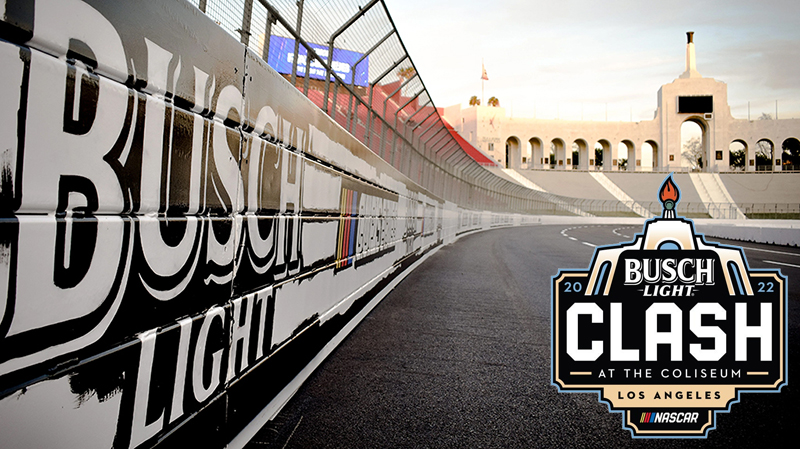
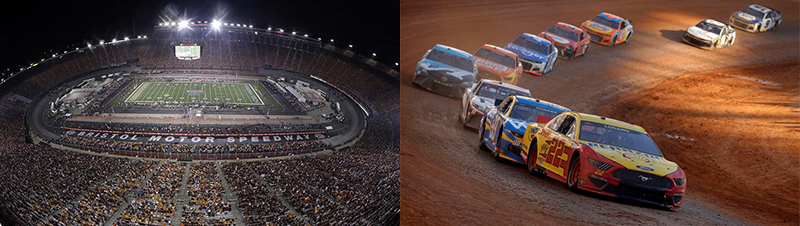
It’s only fair… College football with Tennessee and VA Tech played out at Bristol in 2016. Now, we have NASCAR running inside the LA Coliseum. Granted, the coliseum is marketed as a “multi-use” facility but it is built primarily around a football platform in scale and design. There is also, on any given normal day, no asphalt to speak of inside the coliseum. NASCAR spent over a million dollars to “pave” a 1/4 mile track within the coliseum space in order to run the “Busch Light Clash”.

LEFT: VT vs Tenn at Bristol Speedway (2016) | RIGHT: Bristol Speedway dirt race (2021)

Make no mistake. It’s a gimmick. Football at Bristol was a gimmick. It was done because it could be done and it would be one of those “I was there when…” things or one of those “different to be different” experiences. That football game, however, may have sparked an idea which made the Bristol “dirt track” transformation possible. (Another gimmick… Fun to watch and a good race, when it got going… But still a gimmick)

There are any number of short tracks across the country that would have loved to have the exposure and experience of having NASCAR bring their biggest names into their space. Size, however, does make a difference. It could be argued that the “Clash” is a television event with far more viewers on their couch than in the stands. That can be said of any televised sport. In person ticket sales and on-site fan experiences are a another big part of the success. The LA Coliseum is huge and can hold over 70,000 people. (*masks and proof of vaccine / negative test are among the attendance rules)

There aren’t any “weekend” type race tracks that can accommodate that kind of on site volume. Taken in the context of television and ground level interest for the sport in general, would it not be beneficial to have “The Clash” move about the country showcasing short track racing? It is a harsh reality for many of these tracks that attendance is down and interest is being split to other types of entertainment. Highlighting these types of tracks and the racing within by having NASCAR bring a big show to one or more could make a big difference. Look at the interest in the new SRX Super Star series, for example…

SRX Racing coming to South Boston Speedway – June 25, 2022

However this plays out it will be interesting. Practices and qualifying are Saturday (Feb 5) with heat racing and the main event Sunday (Feb 6) afternoon and evening.

The Daytona 500 is coming up on February 20th with the “Duels” run the Thursday before. ARCA, Xfinity and Camping World series also go green. The “Clash” at the coliseum is a minor distraction from all the action centered at Daytona. The ROLEX 24 just ran and NASCAR will ramp up.
But first, let’s go to the other side of the country with an expensive gimmick to start the season…

It’s on! Temperatures are a little chilly for Florida but the racing is set to roll with the sun. Rain is not in the forecast for Daytona and the ROLEX 24 is on the grid with 61 entries over 5 classes. The driver list is deep with talent from across the motorsport spectrum. Once again, to get up to speed on who is driving what and how the colors and numbers play out, get the Official ROLEX 24 Spotter’s Guide from Andy Blackmore Designs!

Racing has already begun with IMSA as the Michelin Pilot Challenge / BMW M Endurance Challenge raced Friday, January 28. Porsche made a big appearance with their 718 Cayman GT4 placing 3 spots in the top 5 including the win with the #28 RS1 team in the Grand Sport class. Turner popped their #95 and #96 M4 machines in the third and fifth slots.

In the Touring class, KMW took the checkers with their #5 Alfa Romeo Giulietta Veloce with spots two and three going to the Bryan Herta Hyundai teams.

Saturday racing will begin with the IMSA Prototype Challenge set for Saturday morning. For watching the ROLEX 24, the options present variety and choice. Flag to flag coverage is available on Peacock, NBCSports.com and the NBC Sports app. An active subscription to a cable provider or a nominal fee may be required to watch this way. Broadcast times vary across standard NBC or USA TV.

Yes. Yes it is a bit confusing and just a little frustrating as NBC shut down NBCSN in favor of Peacock and the app pay gates. On the other hand, it is not expensive and their is a large variety of programming outside of IMSA.

Catch what you can as the ROLEX 24 goes green with the IMSA / WeatherTech schedule for 2022!

It’s time. Literally. This weekend the “Roar” is set for testing and practicing for the ROLEX 24 which goes green the following weekend. Next month, the Daytona 500 will start NASCAR with a new car design. With that, NASCAR is not heavily represented with the “Roar” and ROLEX this time around. On the surface, it would seem a good idea as some aspects of the “Next Gen” Cup Car are pulling from the IMSA racing style. As examples, consider the center hub wheels and the refueling system. NASCAR Xfinity Series Champion Austin Cindric may be a lonely representative racing a Mercedes in GTD Pro.

IndyCar, however, has a wider set of drivers ready to rolling out with the opening weekends for IMSA. Jimmie Johnson, NASCAR champion and current IndyCar driver, will drive with ALLY / Action Express. Defending IndyCar champion Alex Palou will be racing Ganassi Cadillacs with Scott Dixon and Marcus Ericsson. Meyers Shank Racing team mates Helio Castroneves and Simon Pageanud are running. Alexander Rossi is also in a seat for the ROLEX.

A big thing missing from IMSA for 2022 is NBCSports. NBCSN had been a staple on cable systems for quite some time. Now, in order to watch the bulk of IMSA racing, a pay gate subscription to NBC Peacock TV is required. Note that the late season NASCAR races will be on broadcast NBC or cable USA. The Peacock subscription is only $4.99/month and brings with it a lot of sport and entertainment, including expanded coverage of the upcoming Winter Olympics. It is, however, a bit of a kick to add yet another subscription to those most of us already have.

Some fans, based on social media discussions over the “ROAR” weekend, seem to be put out just as the season gets started. Beyond any perceived difficulties in watching the races, the “old ways” discussions are popping once again. What is it about race fans, surrounded by technology every day, that make them complain about change on every level? It has to be obvious that automotive technology has progressed to the point that there is no “going back” to racing like it was even 10 years ago. Computers, engineering and safety as a constant concern with competition have pushed all of motorsport to review everything that happens on race tracks.

This weekend, as the “Roar before” practices and runs some of the qualifying, IMSA has apparently stepped in with some changes. This has folks that are bigger fans of confrontation instead of competition throwing accusations and pointing fingers. It comes down to the “Balance Of Performance” to maintain a level field of competition. Fuel capacity changes along with some performance adjustments have some fans claiming this is an effort on IMSA to give advantages to certain manufacturers or teams.

Let’s be real, here… IF there was an effort to give an advantage to a team (or teams) by the sanctioning body (IMSA) that was so obvious that the average domestic beer consumer could see it then, certainly, the owners and drivers on site and being supplied with these rule changes would see it. The money and logistics involved in racing at this level would not allow BoP changes to make it unsustainable. No team is going to field a car if they can see from the onset there is no competitive chance on race day. Perhaps some race fans watch too much professional wrestling…

Corvette was given a slightly larger air restrictor… BMW has a bit more boost… Ferrari has a little more boost but also a weight increase… Fuel capacities were adjusted…

Obviously… The world is ending…

The ROLEX 24, despite these changes and the beer fueled criticisms, will run the last weekend of January. It is a an event full of variety, speed and color. Sixteen manufacturers, plus the prototype chassis suppliers, are represented with this endurance race to officially open the United States racing season. Check your Peacock status and let’s go racing!

IMSA online – IMSA, Info, Schedules, Results

Peacock TV – Online subscription

Daytona International Speedway – Raceday Info and Schedules

2022 is starting much like 2021. This pandemic thing is still with us and causing all sorts of issues. How those issues play out as the racing season begins to look at green flags is yet to be seen.

However, some of the changes coming to racing within the sport are quite extensive. As January opens, the eyes turn to Daytona and IMSA / WeatherTech. The ROLEX 24 will see some changes in the classes such as GTD Pro instead of GT Le Mans. GT Daytona retains the designation from before. To review the classes and schedule for the upcoming season, check IMSA / WeatherTech online.

Daytona remains in focus, of course, as IMSA rolls out and NASCAR rolls in for the season opener Daytona 500. It is here that 2022 racing will showcase change on a scale unprecedented in NASCAR. The engineering and styling in the move to the 2022 Next Gen car far surpasses the changes that brought in the “Car of Tomorrow” over the familiar late model style. The 2008 CoT brought forth a new focus on driver safety with chassis, seating and cage enhancements. The Gen-6 Cup car that is being retired as of last season brought body shapes closer to manufacturer versions and put other progressions in place such as digital dash panels and more views on safety.

The Next Gen car making its debut in the Cup series is a leap in every way. The styling is meant to further represent manufacturer street versions. The body is now a composite of carbon fiber and plastic instead of sheet metal. Team fabrication shops will be focusing on Xfinity or Camping World series chassis as Cup cars will have a uniform central chassis that is the same for all. The front and rear suspension and drive train are also fairly uniform and bolt on to the common subframe. Independent suspension and rack and pinion steering change up the handling while a 5 speed sequential transmission replaces the 4 speed pattern. Larger brakes mean a step up to larger wheels. 18 inch aluminum wheels with a center axle lug replace the 5 lug steel wheels. This may be the most obvious change to fans as these wheels will look much different than before. The refueling system and wheel changes may resemble the pit stops of the sports cars which just ran a few weeks before at the ROLEX 24. Goodyear Eagles are still the tires on the track but with a wider stance and lower profile than before.

“Next Gen” NASCAR Cup Car new for 2022 – See more at NASCAR.com

Fans should be excited for the new season and the changes. However, hangers on to the past still haunt the sport. Some just can’t get over the wall with the changes that have come along since the death of Dale Earnhardt. They can’t seem to grasp that time and technology have influenced safety and cost beyond the “good old days” and there is no going back. However, NASCAR can and should do a better job of bringing the personalities of the drivers and teams closer to the fans. Many tracks have embraced the concept with expanded access to garages and infield viewing. The fans follow drivers. The drama is not based on the cars but the interaction of the drivers is what pumps the attention of the fans. The tracks that do well have embraced the national aspect of the sport while inviting the local flavor of the fans in the area.

The local short tracks, the ovals from the hard pack dirt to the paved historic starters of the sport, are also gearing up for some performance changes. The fans may not notice but the teams and the drivers have been busy over the “off season” to make sure their cars are up to the match standards set in place for 2022. There are some body allowance rules and some chassis enhancements that will need attention before the first late model green flag drops for 2022. Hopefully, there has been some “catch up” time for the tires to get stocked for the demand. The late season of 2021 had races cancelled and tracks scrambling for tires just to make events on the basic level.

The costs of NASCAR sanctioned late model style racing has been a hurdle for many and low “car counts” at many tracks has been an issue. Fans want a show and 5 cars on track doesn’t really bring it. New rules are trying to address these cost issues but racing is often a money pit that is hard to fill. Tracks are looking at new events and new types of racing to bring in participants and fans. Drivers, tracks, sponsors and fans are facing some challenges but tracks are committed to push on.

INDYCar is putting off major changes to next year. An expanded hybrid engine system is expected. Formula 1 is putting a number of changes in place for 2022. Much like NASCAR, F1 is putting emphasis on competition and expanded safety. Aerodynamic downforce through wing and body shape design should enhance close racing with better stability. Larger wheels and low profile tires should also enhance handling and reduce heat in race conditions. The front wing and nose have a new design and the rear wing has rounded, rolled tips. F1 changes are targeted, like NASCAR, to engage racing from the driver to the fans.

Other series will likely have some changes. NHRA, for example, is expanding some options for engine performance in some of the classes. Rallycross is looking at some format changes to increase competition. Motorcycle racing from superbike to motocross may also make a change or two for the upcoming season but who can tell…? Those 2 wheel racers are a bit off to begin with…

Expectations are high for many. Short tracks, dirt tracks and other small and local racer venues are looking at their own challenges moving into the year. Drivers and teams are digging for sponsors to carry to the tracks but racing will need attendance to thrive. For 2022, racing fans should take a little time and visit the tracks that run every weekend instead of just holding out for the “Big Guns” in the national series to visit a handful of tracks.

Let’s go local. Let’s go racing.